
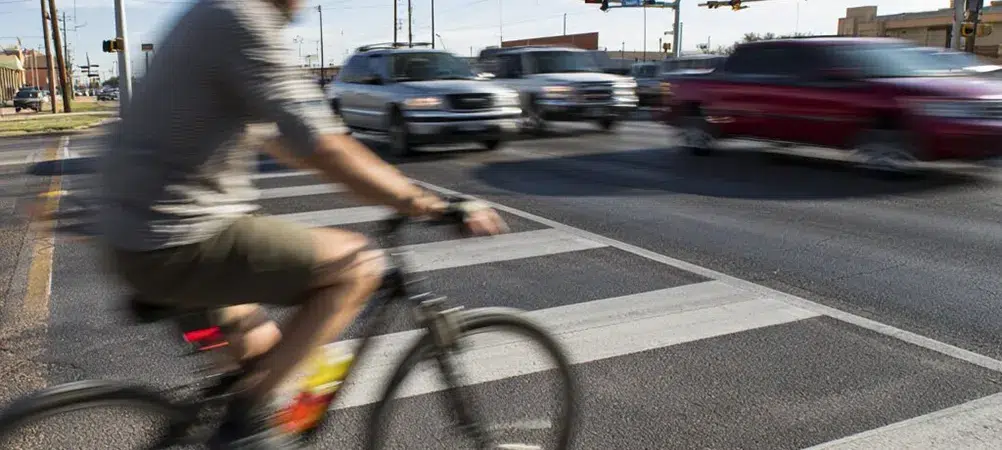
In Texas, liability in bicycle accidents falls on whoever caused the crash through negligence, meaning they failed to act with reasonable care. That is most often a careless driver, but a government agency, road contractor, product manufacturer, or property owner can also be responsible.
More than one party can share fault, and Texas law determines how that shared fault affects your financial recovery. Here are the most common liable parties in Texas bicycle accident cases:
Property owners: Unsafe driveways, parking lots, and construction debris on private property can trigger a premises liability claim, meaning the property owner failed to keep the space reasonably safe.
Drivers and employers: Distracted, speeding, or inattentive drivers cause the majority of bike crashes. If the driver was working at the time, think delivery drivers or commercial truckers, their employer may also be responsible.
Local governments and road contractors: A city or county can be liable for dangerous road conditions, missing signage, or unrepaired potholes. Private contractors who create hazards in construction zones can also be held accountable.
Product manufacturers: If a defective brake, frame, or helmet contributed to your injuries, you may have a claim against the manufacturer or the retailer who sold it.
Texas treats bicycles as vehicles under the Transportation Code, so both cyclists and drivers have specific legal duties on the road. When those duties are violated, the injured party has the right to pursue compensation for medical bills, lost wages, and pain and suffering.
Texas’s modified comparative negligence rules then determine exactly how much you can recover based on each party’s percentage of fault.
What Texas Bicycle Laws Impact Fault?
Under Texas Transportation Code §551.101, bicycles are treated as vehicles. That means you have the same rights on the road as a driver, but also the same legal duties.
Insurance companies will immediately look for any traffic law you violated to shift blame onto you. Here is what the law requires:
- Traffic laws apply to cyclists: You must obey signals, stop signs, and lane rules just like any driver.
- Lane position: You must ride as close to the right side of the road as practicable, with exceptions for hazards, turns, or narrow lanes.
- Required equipment at night: A front white light visible from 500 feet and a rear red reflector or lamp are required by law. A working brake is mandatory at all times.
- Sidewalk rules vary locally: Texas has no statewide ban on sidewalk riding, but local ordinances, including here in Lubbock, set their own rules.
Drivers also owe cyclists a legal duty to pass safely and maintain a proper lookout. Failing to do so is one of the clearest signs of driver negligence.
How Comparative Negligence Affects Your Recovery
Texas uses a system called modified comparative negligence. This means you can still recover compensation even if you were partially at fault, but only if your share of blame is 50% or less.
Your total award is reduced by your fault percentage. If a jury finds you 3% at fault on a $100,000 claim, you recover $97,000. If you cross the 51% line, you recover nothing.
| Your Fault Percentage | Recovery on a $100,000 Claim | Practical Result |
| 0% | $100,000 | Full recovery |
| 20% | $80,000 | Reduced recovery |
| 50% | $50,000 | Half recovery |
| 51% | $0 | No recovery |
This is why fault allocation becomes the central battle in almost every bicycle accident case. Insurance companies are trained to push your percentage as high as possible to reduce or eliminate what they owe you.
When multiple defendants are involved, each party is assigned a specific percentage of fault by the jury, and the total must equal 100%.
If one defendant is found more than 50% at fault, joint and several liability applies, meaning you can collect your entire judgment from that one party, even if others share some blame.
What Evidence Proves Liability After a Bike Crash?
Strong evidence is your best defense against inflated fault percentages. The more clearly we can show what the other party did wrong, the harder it is for the insurance company to blame you.
Here is the evidence I prioritize immediately after you hire me:
- Police crash reports: Officers’ initial fault observations carry real weight with insurance adjusters and juries.
- Witness statements: Independent bystanders provide unbiased accounts, but their memories fade fast.
- Surveillance and dashcam footage: Traffic cameras, nearby businesses, and dashcams often capture the crash on video.
- Driver cell phone records: These can prove the driver was texting or calling at the moment of impact.
- Medical records: Immediate treatment creates an official record linking your injuries directly to the crash.
- GPS and ride-tracking data: Apps like Strava or Garmin can provide your exact speed, lane position, and the precise time of impact.
Physical evidence disappears quickly. Skid marks wash away, footage gets deleted, and witnesses forget details. That is why, as an experienced Texas bicycle accident lawyer, I move fast to preserve everything the moment you contact me.
Common Liability Scenarios in Texas Bike Crashes
Most bicycle crashes follow predictable patterns, and each one has a clear liability fingerprint. Knowing which scenario matches your crash helps us identify exactly which traffic law the driver violated.
- Right hook or left cross: A driver turns across your path at an intersection. The driver almost always had a legal duty to yield.
- Dooring: A parked driver opens their door into a passing cyclist. The person opening the door is responsible for checking first.
- Unsafe passing: A driver crowds you off the road or merges without checking their blind spot, violating Texas’s safe-passing requirement.
- Failing to yield: A driver runs a stop sign or red light and hits you in the intersection.
- Hit and run: When the driver flees, your own uninsured motorist coverage typically becomes your path to recovery.
What if I Was Not Wearing a Helmet?
Texas does not require adult cyclists to wear helmets, and choosing not to wear one does not bar your injury claim. Insurance adjusters will try to argue that your head injuries are your own fault. I push back hard on that argument by keeping the focus where it belongs, on what the driver did wrong.
Missing lights at night is a different situation, since those are legally required. An equipment violation can shift some fault percentage onto you, but it rarely eliminates your right to recover entirely.
Can I Sue the Government for a Road Hazard Crash?
Yes, but government claims are subject to strict rules under the Texas Tort Claims Act. The Texas Tort Claims Act is a law that allows you to sue a city, county, or state agency for certain types of negligence, including dangerous road conditions. The catch is that the deadlines are much shorter than a standard injury claim.
Many Texas cities require formal written notice within 30 to 90 days of the crash. Miss that window, and your claim is gone permanently. To win, you also need to show that the government knew or should have known about the hazard maintenance records, prior complaints, and 311 call logs are critical pieces of evidence here.
What Compensation Can You Recover After a Bicycle Accident?
You can recover both economic damages, your financial losses, and non-economic damages for your physical pain and emotional suffering. In cases involving extreme recklessness, like a drunk driver, punitive damages may also apply.
Here is what a full bicycle accident claim typically covers:
- Medical expenses: All past and future care, including surgery, physical therapy, and assistive devices.
- Lost wages and earning capacity: Income you missed while recovering, plus reduced future earnings if your injuries are permanent.
- Pain and suffering: Compensation for daily physical pain, emotional distress, and loss of enjoyment of life.
- Property damage: Fair market value to repair or replace your bicycle, helmet, cycling computer, and gear.
How Long Do You Have to File a Bicycle Injury Claim in Texas?
You have two years from the date of the crash to file a lawsuit under Texas Civil Practice & Remedies Code §16.003. Miss that date, and the court will permanently dismiss your case, regardless of how strong your evidence is.
If your claim involves a government entity, your deadline is far shorter, sometimes just 30 days for formal written notice. That is why I always recommend contacting Perrin Law PLLC Injury & Accident Lawyer as soon as possible after a crash, not months later when evidence has disappeared, and deadlines are closing in.
What to Do After a Bicycle Accident in Texas
The steps you take in the first 24 to 48 hours directly protect your health and your legal claim. Here is exactly what to do:
- Call 911: Always get police and paramedics on the scene, even if you feel okay.
- Get medical attention immediately: This creates an official record linking your injuries to the crash.
- Document everything: Photograph the driver’s vehicle, license plate, your bike, and the road conditions.
- Collect witness information: Get names and phone numbers before anyone leaves the scene.
- Preserve your gear: Do not repair your bike or wash your clothing they are physical evidence.
- Avoid recorded statements: Never give a statement to the at-fault driver’s insurance company without legal representation.
Why Work with Perrin Law PLLC Injury & Accident Lawyer?
I prepare every case as if it is going to trial. That approach puts real pressure on insurance companies to offer fair settlements because they know I am ready to take the fight to court if needed.
You work directly with me, not a case manager or paralegal, from your first call to the resolution of your case. I handle all insurance communications so adjusters cannot use your words against you. And because I work on a contingency fee basis, you pay nothing unless we win your case.
If you were injured in a bicycle crash anywhere in Texas, contact Perrin Law PLLC Injury & Accident Lawyer today for a free consultation.
Frequently Asked Questions
Can a Driver Be at Fault if They Say They Didn’t See Me?
Yes, drivers have a legal duty to maintain a proper lookout for all vehicles on the road, including bicycles. Failing to see a cyclist who is legally using the road is itself an act of negligence.
Can I Still Recover Compensation if I Was Partly at Fault for the Crash?
Yes, as long as you are 50% or less at fault under Texas’s modified comparative negligence rules. Your final award will be reduced by your fault percentage, but you can still recover meaningful compensation.
Does Not Wearing a Helmet Hurt My Bicycle Accident Claim in Texas?
Texas does not require adult cyclists to wear helmets, so the absence of a helmet does not automatically reduce your compensation. Insurers may raise it as an argument, but I challenge that tactic by focusing on the driver’s negligence.
What if the Driver Who Hit Me Fled the Scene?
If the driver cannot be identified, your own auto insurance policy’s uninsured motorist coverage typically applies, even if you were on a bicycle rather than in a car. This coverage is one of the most important protections cyclists have in Texas.
How Long Does a Bicycle Accident Case Take to Resolve?
A straightforward case can settle within a few months, while complex cases that go to trial can take a year or more. The timeline depends largely on the severity of your injuries and how aggressively the insurance company fights the claim.