
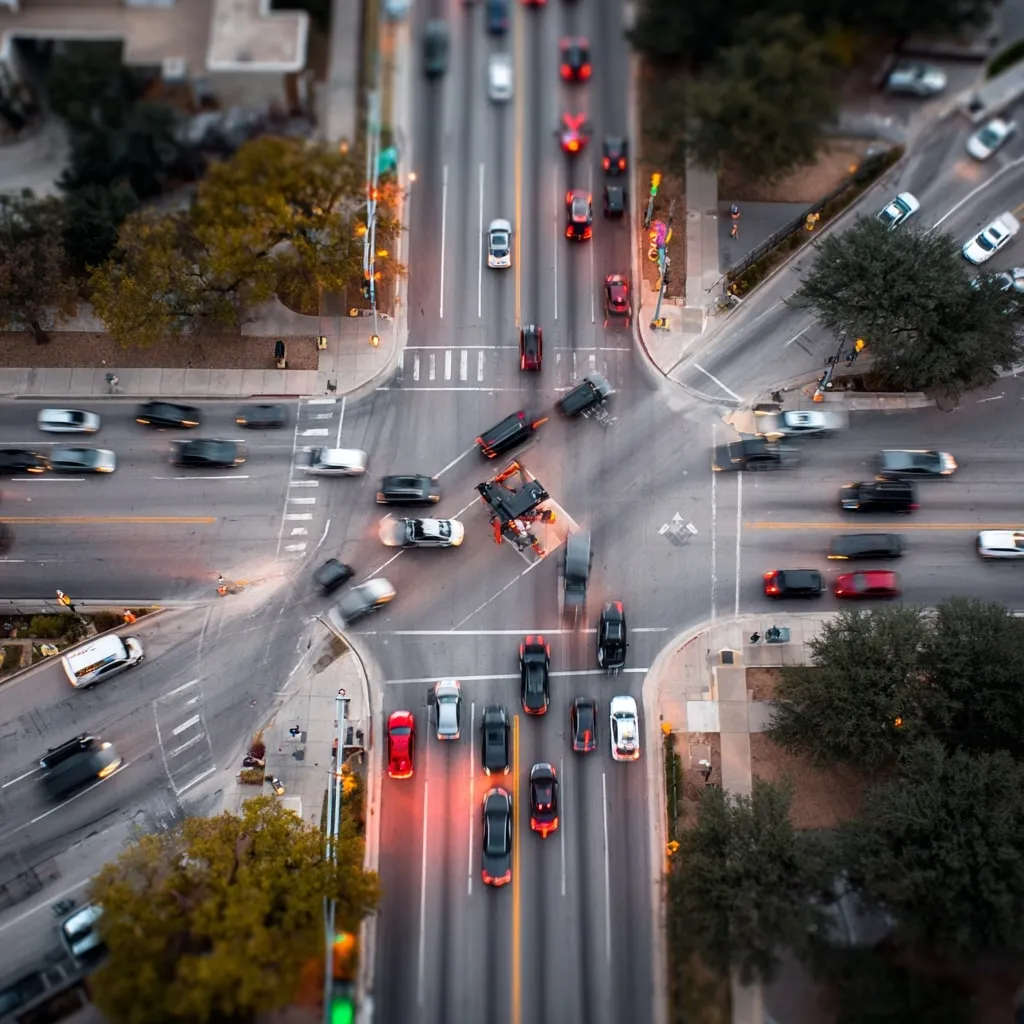
In Texas, right-of-way is the legal right to proceed first in traffic situations. This means Texas law doesn’t “give” you the right-of-way but instead requires other drivers to yield it to you in specific situations.
Even when you have the right-of-way, you still must drive carefully and avoid crashes when possible. Texas right-of-way laws create predictable traffic patterns that keep everyone safer on the road.
Why These Rules Matter for Your Safety
When drivers ignore right-of-way rules, serious accidents happen. Understanding these laws protects you because the driver who failed to yield is usually found at fault in a crash.
This fault determination becomes the foundation of your personal injury claim if you’re hurt. Insurance companies scrutinize these rules to decide who pays for damages.
Who Has the Right-of-Way at Uncontrolled Intersections
An uncontrolled intersection has no traffic signs, signals, or other control devices. The first vehicle to arrive at the intersection gets to proceed first.
If multiple vehicles arrive simultaneously, specific rules determine who goes next. These situations require extra caution since there are no signals to guide traffic flow.
Four-Way Stop Rules
At a four-way stop, the order is based on arrival time and position:
- First to arrive: The first vehicle to come to a complete stop proceeds first.
- Simultaneous arrival: When two vehicles stop at the same time, the driver on the right has the right-of-way.
- Opposite directions: Straight-through traffic goes before left-turning traffic when vehicles arrive together.
T-Intersections and End-of-Roadway Rules
At a T-intersection, one road ends while another continues through. Traffic on the ending road must yield to vehicles on the through street.
This rule applies even without posted signs. The through traffic always has the right-of-way over terminating traffic.
Unpaved to Paved Roads
Vehicles traveling on unpaved or dirt roads must yield to traffic on paved roads. This rule is common in rural Texas areas where dirt roads meet highways.
Private Roads and Driveways
Any vehicle entering a public street from private property must yield. This includes driveways, parking lots, alleys, and private roads.
You must wait for a safe gap in traffic before proceeding onto the public roadway.
Who Has the Right-of-Way at Signalized Intersections?
Traffic signals create clearer right-of-way rules, but confusion still causes accidents. The signal color and type determine who proceeds first.
Green, Yellow, and Flashing Signals
Different signal types create different right-of-way situations:
- Solid green light: You may proceed but must yield to vehicles or pedestrians already lawfully in the intersection.
- Solid yellow light: This warns that your right-of-way is ending, so prepare to stop safely.
- Flashing yellow light: Proceed with caution while yielding to oncoming traffic.
- Flashing red light: Treat this exactly like a stop sign.
Right Turn on Red Rules
In Texas, you can turn right after stopping at a red light unless signs prohibit it. You must come to a complete stop and yield to all cross-traffic and pedestrians before turning.
Some intersections post “No Turn on Red” signs that override this general rule. Always check for these signs before turning.
Left Turns and Oncoming Traffic
Left-turning drivers must always yield to oncoming traffic unless they have a protected green arrow. This is one of the most common causes of serious intersection crashes.
Even with a green light, you must wait for a safe gap in oncoming traffic before turning left.
When Drivers Must Yield to Pedestrians
Texas law requires drivers to yield to pedestrians in both marked and unmarked crosswalks at intersections to prevent pedestrian accidents. Even if a pedestrian crosses improperly, you have a legal duty to avoid hitting them if possible.
Pedestrians have the right-of-way when crossing streets at intersections, whether or not crosswalk lines are painted. This protection extends to disabled individuals using wheelchairs or mobility devices.
Yielding to Emergency Vehicles
When you see an emergency vehicle with active lights and sirens, you must yield immediately. Pull over to the right side of the road and stop completely until the vehicle passes.
This rule applies even if you have a green light or the right-of-way. Emergency vehicles always take priority over regular traffic.
When Drivers Must Stop for School Buses
You must stop when a school bus has flashing red lights and an extended stop sign. Traffic in both directions must stop and wait.
The only exception is on divided highways with physical medians or barriers. If you’re on the opposite side of a divided highway, you may proceed with caution.
Trains and Railroad Crossings Always Have Priority
Trains always have the right-of-way without exception. You must stop at railroad crossings when lights flash or gates are down.
Never try to beat a train across the tracks. Wait until lights stop flashing and gates fully raise before proceeding.
Who Has the Right-of-Way When Merging or Entering Highways?
Traffic already on the highway has the right-of-way over merging vehicles. As the merging driver, you must adjust your speed and find a safe gap to enter traffic.
Highway drivers should move over when possible to help merging traffic, but they’re not legally required to do so. The responsibility falls on the merging driver to enter safely.
Roundabout Entry and Yielding Rules
Traffic already circulating inside a roundabout has the right-of-way. Entering drivers must yield until there’s a safe gap to proceed.
Once you’re in the roundabout, you have the right-of-way over vehicles trying to enter.
What Texas Law Says About Stop and Yield Intersections
Texas Transportation Code Section 545.153 outlines yield sign requirements. Unlike stop signs that require complete stops every time, yield signs require you to slow down and stop only when necessary.
You must yield to other vehicles or pedestrians that would create a hazard if you proceeded.
Prima Facie Proof at Yield Signs
Prima facie means evidence that proves something unless contradicted by other proof. If you crash immediately after passing a yield sign, the law presumes you failed to yield properly.
This presumption becomes strong evidence against you in both criminal and civil cases. It shifts the burden to prove you actually yielded when required.
Penalties for Failure to Yield in Texas
Failing to yield carries escalating penalties based on the consequences:
- Basic violation: Standard fines and points on your license.
- Causing injury: Fines between $500 and $2,000.
- Causing serious bodily injury: Fines up to $4,000.
These criminal penalties are separate from civil liability for the victim’s medical bills, lost wages, and other damages.
How Right-of-Way Violations Affect Fault and Compensation
A failure-to-yield ticket creates powerful evidence of negligence in injury claims. Insurance companies use these violations to assign blame and reduce payouts.
Texas right-of-way laws help establish who was at fault when crashes occur at intersections or during merging situations.
Texas 51 Percent Bar Rule
Texas uses a modified comparative fault system with a 51% bar rule. You can only recover damages if you’re 50% or less at fault for the accident.
If a jury finds you 51% or more to blame, you recover nothing, regardless of your injuries. This makes fault determination critical in right-of-way cases.
Evidence That Proves Failure to Yield
Strong evidence protects you when the other driver failed to yield:
- Police reports: The officer’s fault determination carries significant weight.
- Witness statements: Independent observers provide neutral accounts of what happened.
- Traffic cameras: Video footage offers undeniable proof of signal status and vehicle positions.
- Physical evidence: Vehicle damage patterns and debris fields help reconstruct the crash.
What to Do After a Failure-to-Yield Crash
The steps you take immediately after a crash protect both your health and legal rights. Stay calm and focus on documentation and safety.
Critical Steps at the Scene
Take these actions while still at the crash site:
- Check for injuries and call 911: Your safety comes first.
- Document everything: Photograph the intersection, traffic signs, vehicle positions, and damage from multiple angles.
- Collect witness information: Get names and phone numbers from anyone who saw the crash.
- Stick to facts only: Avoid admitting fault or apologizing when speaking with police or other drivers.
Essential Actions After Leaving the Scene
Seek medical attention immediately, even if you feel fine. Some injuries don’t show symptoms right away but can become serious later.
Report the accident to your insurance company but don’t give recorded statements to the other driver’s insurer. Their goal is finding ways to blame you for the crash.
Keep detailed records of all medical treatment, missed work, and expenses related to your injuries.
How Insurance Companies Use Right-of-Way Rules Against You
Insurance adjusters know Texas right-of-way laws inside and out. They use these rules to minimize payouts by arguing you contributed to the crash.
Adjusters ask leading questions designed to get you to admit fault. They might ask if you were running late, distracted, or could have stopped sooner.
Since Texas follows comparative fault rules, adjusters inflate your fault percentage to justify lower settlement offers, often being blamed for an accident that wasn’t your fault. They know that even partial fault reduces what they owe you.
This is why, as an experienced auto accident attorney in Lubbock, Texas, I handle all insurance communications for my clients. Adjusters can’t trick you into damaging admissions when they’re talking to me instead.
When Right-of-Way Rules Apply to Different Types of Crashes
Texas right-of-way laws affect fault determination in various accident types. These rules apply whether you’re in a car accident, truck collision, motorcycle accident, or pedestrian incident.
The same principles govern crashes involving commercial vehicles, including truck accidents, government vehicles, and private cars.
In wrongful death cases, the deceased person’s failure to yield can reduce the family’s recovery under comparative fault rules.
Building a Strong Case When Someone Violates Your Right-of-Way
At Perrin Law PLLC Accident & Injury Lawyer, I start investigating right-of-way cases immediately to preserve crucial evidence. Skid marks fade, witnesses forget details, and video footage gets overwritten quickly.
My investigation focuses on proving the other driver’s violation while minimizing any fault assigned to you. This approach maximizes your potential recovery under Texas law.
I prepare every case as if it’s going to trial because insurance companies take your claim more seriously when they know you’re ready to fight.
Experienced Car Accident Law Firm in Lubbock, Texas
If another driver’s failure to follow Texas right-of-way laws injured you, you deserve justice. Insurance companies will try to blame you to avoid paying what you’re owed, but I fight back against these tactics.
I have extensive experience handling right-of-way cases and know how to prove the other driver’s negligence. My thorough preparation often leads to better settlement offers because insurers know I’m ready for trial.
You don’t pay me anything unless I win your case. This means I only succeed when you succeed, so there’s no financial risk in getting the legal help you need.
Frequently Asked Questions
Can You Turn Left on Red in Texas?
You can only turn left on red when turning from a one-way street onto another one-way street after coming to a complete stop.
Who Goes First at a Four-Way Stop?
The first vehicle to come to a complete stop proceeds first, and if two cars arrive simultaneously, the driver on the right has the right-of-way.
Do Pedestrians Always Have the Right-of-Way in Texas?
Pedestrians have the right-of-way in marked and unmarked crosswalks at intersections, but they must still exercise reasonable care for their safety.
Does a Failure-to-Yield Ticket Automatically Prove Civil Fault?
While it’s very strong evidence of negligence in a civil claim, it’s not automatically the final word on liability determination.
What Is Prima Facie Evidence at a Yield Sign?
Prima facie evidence means the law presumes you were at fault if you caused an accident immediately after passing a yield sign without stopping.
How Long Do I Have to File an Injury Claim in Texas?
The statute of limitations for personal injury claims in Texas is two years from the date of your injury.
Should I Give a Recorded Statement to the Other Driver’s Insurance?
I strongly advise against giving recorded statements to the at-fault driver’s insurance company before consulting with an attorney.
What Evidence Best Proves a Failure-to-Yield Case?
Video footage from traffic cameras or dashcams, neutral witness testimony, and detailed police reports provide the strongest evidence in these cases.